
In "The Art of Possibility" Zander and Zander explain the practice of giving an A as the conscious realization and appreciation of everyone's individual contribution as a true and valid offering, not to be measured against one's own expectations. Far from just giving someone the benefit of the doubt, giving an A is the recognition of someone's infinite potential.
As mentioned in a previous post, I started reading this book during the break we had immediately before starting Media Asset Creation. When I got to the chapter about giving an A, I thought for sure Mr. Bustillos was going to follow suit and have us all write letters that began:
Dear Mr. Bustillos, I got my A because...
Below would have been my response.
Dear Mr. Bustillos,
I got my A because I would have never settled for less. Please allow me to explain... It's not the grade that I covet, nor any sort of outward measure of my success or failure in the course. What really mattered to me was my own perception of how hard I tried.
You see, I've always known higher education was in the cards for me, yet I promised myself I would not commit to a program that I wasn't wholeheartedly sure of. When I discovered Full Sail's EMDT program, I literally jumped out of my chair and did a happy dance. In that instant, a million little dots started connecting in my mind forming the shape of my future.
I was determined that the EMDT program and every course that composed it be a catalyst for professional growth, the alignment of my interests and talents. As such, I have given it my all... from blisters to bliss... all of me.
Without having to worry about a grade, I felt self-conscious that my work-product/effort for the class wasn't meeting your expectations/objectives. Then I realized, it was my own expectations that I needed to exceed... and I did. The sandbox you provided allowed me a safe environment to explore and reflect on my purpose in the class, the EMDT program and beyond. The experience was a personal one - challenging my strengths, weaknesses and, most importantly, my perception of the two.
I've found comfort and reward in turning every challenge before me into an opportunity for growth. I am now a better version of me.
Sources:
Zander, R. & Zander, B. (2002). The art of possibility: Transforming professional and personal life. New York: Penguin Books.
Flash animation created and posted by Emily Wray at http://blip.tv/file/2386806/
Tuesday, July 21, 2009

Monday, July 20, 2009
Week 3: The Art of Possibility
Speaking of a labor of love... I can't wait to get back into Zander and Zander's, "The Art of Possibility." I say "back" because I sped through first half during our recent holiday break. I almost feel guilty nestling into this book... it almost feels like... dare I say it... READING FOR PLEASURE!
I knew I recognized the name Benjamin Zander... but I couldn't remember from where! That is until I saw that Mr. Bustillos had posted this video on FSO. Fellow classmate Kim Zalepa turned me on to this particular TED presentation in month 3. Brilliant!
Sources:
Zander, R. & Zander, B. (2002). The art of possibility: Transforming professional and personal life. New York: Penguin Books.
TED.com. (2008). Benjamin Zander on music and passion. Retrieved July 20, 2009, form http://www.ted.com/talks/benjamin_zander_on_music_and_passion.html
Week 3: Who's Bad?
Inspired by a colleague... in more ways than one!
The above mash-up was created by the very talented Mr. Abram Siegel. Quite obviously a labor of love, this mash-up is a perfect example of remix culture done right... by which, I mean, done "fairly."
At first glance, you might be thinking to yourself - "oh my, he's committed a gazillion copyright violations... I hope he has a good lawyer." However, according to the Center for Social Media's Code of Best Practices in Fair Use for Online Video, not only is Mr. Siegel not in violation of any copyright laws, he is furthering the cause of and his right to fair use.
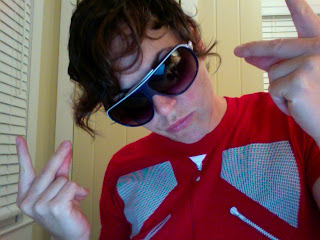
Based on the best practices outlined in the document referenced above, Mr. Siegel's brilliant mash-up invokes fair use under the following criterion:
1) As an example of reproducing content in order to memorialize one of the greatest artists of our time;
2) As a catalyst for a discussion on fair use best practices; and
3) As a remix of copyrighted elements combined to create an entirely new work.
Bravo Mr. Siegel for a well-executed and well-timed contribution to the class discussion!
PS. Can you tell that's MJ's famous "Beat It" jacket on my t-shirt?!?
Sources:
Center for Social Media. (2008, June). Code of best practices in fair use for online video. Retrieved July 20, 2009, http://web.me.com/edm613/media/online_best_practices_in_fair_use.pdf
Siegel, A. (2009.) Michael Jackson mash-up tribute. Retrieved July 20, 2009, from http://www.youtube.com/watch?v=8govZkEZaC0&feature=player_embedded
Image Credit: Photograph taken by Emily Wray.
The above mash-up was created by the very talented Mr. Abram Siegel. Quite obviously a labor of love, this mash-up is a perfect example of remix culture done right... by which, I mean, done "fairly."
At first glance, you might be thinking to yourself - "oh my, he's committed a gazillion copyright violations... I hope he has a good lawyer." However, according to the Center for Social Media's Code of Best Practices in Fair Use for Online Video, not only is Mr. Siegel not in violation of any copyright laws, he is furthering the cause of and his right to fair use.

Based on the best practices outlined in the document referenced above, Mr. Siegel's brilliant mash-up invokes fair use under the following criterion:
1) As an example of reproducing content in order to memorialize one of the greatest artists of our time;
2) As a catalyst for a discussion on fair use best practices; and
3) As a remix of copyrighted elements combined to create an entirely new work.
Bravo Mr. Siegel for a well-executed and well-timed contribution to the class discussion!
PS. Can you tell that's MJ's famous "Beat It" jacket on my t-shirt?!?
Sources:
Center for Social Media. (2008, June). Code of best practices in fair use for online video. Retrieved July 20, 2009, http://web.me.com/edm613/media/online_best_practices_in_fair_use.pdf
Siegel, A. (2009.) Michael Jackson mash-up tribute. Retrieved July 20, 2009, from http://www.youtube.com/watch?v=8govZkEZaC0&feature=player_embedded
Image Credit: Photograph taken by Emily Wray.
Week 3: An Open Letter to Dr. Holly Ludgate

An idea worth sharing...
Dr. Ludgate,
I was just musing on one of our discussion boards about the value the blogs we've been required to create this month (MAC). It is such a great tool for reflection that I wish I had been keeping one the entire time I've been in the EMDT program. Not only could it have been a diary of my personal journey, but it could also serve as a resource for students that follow. I've also found that the free flow writing has really helped me with my thesis, if only by offering the practice of getting the words out of my head and onto to the screen.
I digress.... The point of all this, you ask? I think it should be a requirement that EMDT students create a blog from the start and regularly post to it throughout the duration of the program. The discussion boards serves a similar purpose, but they disappear at the end of each month. A blog would be/could be a living record of our experience in the program and beyond. Imagine how cool it would be if students continued to blog even after they graduated and moved into their professional adventures!
Hope you're well,
Emily
Image Credit: Stock photography purchased by Emily Wray from http://www.photos.com.
Week 3: Ron Smith Interview Interactive Q&A
1) Where does Ron Smith teach?
New Media Academy, Hollywood High School – Hollywood, CA
2) What is the focus of the New Media Academy?
The New Media Academy is career-focused, with the goal of getting its students into the entertainment industry.
3) In addition to wanting their students to go to college, what does the New Media Academy hope to get their students involved with contemporaneously?
Getting their students on a career path with internship and mentorships in the industry
4) What does Ron Smith use in his classroom to get his students engaged?
Anything fair or unfair – including dancing around the room
5) How does Ron Smith use his classroom as a laboratory?
He uses his students as scientists to explore new technologies as they emerge
6) Give 2 examples of these emerging technologies.
Podcasts and Text Messaging
7) How does Ron Smith account for individual differences in his classroom?
He allows them to express themselves individually through the medium of their choice
8) What are the two mediums he provides as examples?
Flash Animation and Graphic Design
9) Does Ron Smith believe teachers or students are more technically adventurous?
Students
10) Fill in the blank: “Teachers think they’ve crossed the rubicon if they can make a good __________.”
PowerPoint
11) Ron Smith insists his students go beyond PowerPoints by doing what?
Creating Flash presentations and posting the on the web
12) Ron Smith says that digital teaching is “front-loaded.” What does he mean by that?
There’s a lot of work at the beginning, developing curriculum. There is a lot of prep work with teaching digital media.
13) What is Scratch?
A free open-source program, developed by MIT, for creating games
14) What is Sketch-up?
A free program, created by Google, used for 3-D modeling
15) What type of project does Ron Smith suggest using Sketch-up?
The development of a movie created using different scenes generated in Sketch-up
16) What other Google tools can you import into Sketch-up?
Google Maps and Google Earth
17) What is Blender?
Free 3-D animation open source software
18) How much technical instruction does Ron Smith give his students on using Scratch, Sketch-up and Blender?
Relatively little – He introduces them to the program interface, then asks them to explore and create.
19) What is Ron Smith’s answer to the question, “Well how do I do that?”
“I don’t know – You figure it out.”
20) What educational trend does Ron Smith see developing?
The movement of curriculum online to service learners at various places in their education
Source:
Media Asset Creation. (2009). Interview with Ron Smith. Retrieved July 20, 2009, from http://www.youtube.com/watch?v=h0e3YlOFPcQ&feature=player_embedded
Friday, July 17, 2009
Week 2: Generation ReMix...
If an effort to share knowledge, my small group decided it would be cool to each post an entry to our blogs about a subject we felt like an expert in.
While I would never classify myself as a “graphic design expert,” I do have a lot of experience working with the medium.
One of the most challenging parts of being a designer is balancing how much ($$$) you believe your creative skills are worth with what clients are willing to pay for your time. Often times designers work (brainstorming/revising) many more hours than they actually bill. The seamless integration of the business process and the creative process can be tricky.
With the advent and proliferation of stock images, layouts and templates it’s even harder to convince a client they should pay $X.XX amount for an original design, when they could be paying half as much for something pre-packaged. What’s a designer to do?
I figured there had to be a way for a designer to capitalize on the availability and affordability of stock imagery… and I think I found one...
Instead of creating a custom logo from scratch, which would take anywhere from 4-6 hours (not including revisions), I’ve started to purchase component pieces from stock image sites and to edit them into something completely new. It ends up taking me half the time to design a logo, with only a small cost to me for the stock image. Working this way, by remixing parts, is more efficient for me as a designer and cheaper for my clients.
An added bonus is the gradual accumulation of my own stock image repository.
Here’s an example of the process at work…
Client: Mobile Muscle
Need: This young up-start company was looking for a logo that would visually communicate their mobile personal training service, geared primarily toward women. I was given no other information and no parameters to constrain my imagination.
After sketching a crude design on paper, I decided I wanted to create a logo that looked like a tire (mobile) with flexing biceps (muscle).
With that idea in mind, I headed to istockphoto.com where I searched images reflective of the two main components: a tire and flexed biceps. That part was easy enough. Below are the two source images I purchased to remix into the logo.


I combined what I wanted from each image and added original text created in Illustrator. Below is the end result.
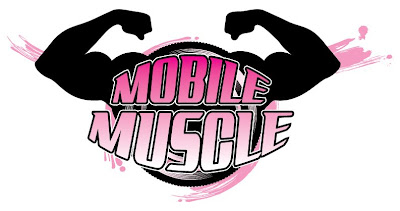
The entire process only took about 2 hours.
Image Credit: Stock images purchased from http://www.istockphoto.com and repurposed by Emily Wray.
While I would never classify myself as a “graphic design expert,” I do have a lot of experience working with the medium.
One of the most challenging parts of being a designer is balancing how much ($$$) you believe your creative skills are worth with what clients are willing to pay for your time. Often times designers work (brainstorming/revising) many more hours than they actually bill. The seamless integration of the business process and the creative process can be tricky.
With the advent and proliferation of stock images, layouts and templates it’s even harder to convince a client they should pay $X.XX amount for an original design, when they could be paying half as much for something pre-packaged. What’s a designer to do?
I figured there had to be a way for a designer to capitalize on the availability and affordability of stock imagery… and I think I found one...
Instead of creating a custom logo from scratch, which would take anywhere from 4-6 hours (not including revisions), I’ve started to purchase component pieces from stock image sites and to edit them into something completely new. It ends up taking me half the time to design a logo, with only a small cost to me for the stock image. Working this way, by remixing parts, is more efficient for me as a designer and cheaper for my clients.
An added bonus is the gradual accumulation of my own stock image repository.
Here’s an example of the process at work…
Client: Mobile Muscle
Need: This young up-start company was looking for a logo that would visually communicate their mobile personal training service, geared primarily toward women. I was given no other information and no parameters to constrain my imagination.
After sketching a crude design on paper, I decided I wanted to create a logo that looked like a tire (mobile) with flexing biceps (muscle).
With that idea in mind, I headed to istockphoto.com where I searched images reflective of the two main components: a tire and flexed biceps. That part was easy enough. Below are the two source images I purchased to remix into the logo.


I combined what I wanted from each image and added original text created in Illustrator. Below is the end result.

The entire process only took about 2 hours.
Image Credit: Stock images purchased from http://www.istockphoto.com and repurposed by Emily Wray.
Thursday, July 16, 2009
Week 2: Reading... A valid albeit slightly humorous analogy...

In his book Convergence Culture, Jenkins writes:
Fan digital film is to cinema what the punk DIY culture was to music. There, grassroots experimentation generated new sounds, new artists, new techniques, and new relations to consumers which have been pulled more and more into mainstream practice. (p. 136)
Although it is a fitting analogy, I still smirk when I think about the comparison of hardcore punk bands like The Ramones and The Sex Pistols being compared to Star Wars geeks.
Yet another similarity between these two groups is their "anti-establishment" ideals, evident in the lyrics of punk music and evident by fan film's disregard for copyright laws.
Source: Jenkins, H. (2006). Convergence culture: Where old and new media collide. New York: New York University Press.
Image Credit: Stock photography purchased by Emily Wray from http://www.photos.com.
Week 2: Reading... A Response to Nick Briscoe

CONVERGENCE CULTURE CHAPTER 4 DISCUSSION WK2 PST1
Here’s the deal. I am not against copyright. I don’t have an issue asking for permission to use material created by others. I do however have an issue with the way certain corporate entities have dealt with the issue thus far. “Marketers have turned our children into walking, talking billboards who wear logos on their T-shirts, sew patches on their backpacks, plaster stickers on their lockers, hang posters on their walls, buy they must not, under penalty of law post them on their home pages. Somehow, once consumers choose when and where to display those images, their active participation in the circulation of brands suddenly becomes a moral outrage and a threat to the industry’s economic well-being.” (Jenkins, 2006, p.142) I completely agree with the aforementioned statement. Corporations desperately need to catch up to the times, and accept the fact that consumers want more interaction.
Companies want their products to become infamous, and love when their products become part of culture, only on their own terms. However, societies and cultures do not work in such a fashion. Once an item becomes part of popular culture and becomes embedded into everyday life, it should be expected that consumers will want to share images, quotes, music, and so on. Particularly when that piece of media means something to the individual, will the desire to express themselves by using favorite media as that outlet. Isn’t imitation the sincerest form of flattery? The point being that a monolithic empire such as Star Wars (1977), for instance, is an example of a beast that cannot be stopped. Countless fan films, posted images, and such. Yet the franchise remains strong, because of its continued discussion and sharing among fans to help keep the flame alive.
I agree that the artists who create material by all means should receive credit, and their due worth. I also believe that corporations and conglomerates such as the RIAA and MPAA need to devise a better solution in which to deal with the issues at hand. Suing fans, criminalizing consumers, locking down products with DRM and the like have not only not worked as well as they would like, but have put them in a bad light.
I don’t only blame the media companies; I blame the law too. There needs to be clearer guidelines written into copyright laws with expansion on fair use (for education, social/cultural freedoms, and other non-commercial usages). As Jenkins (2006, p.142) states “...media companies are giving out profoundly mixed signals because they really can’t decide what kind of relationships they want to have with this new kind of consumer.” Jenkins (2006, p.138) quotes Greg McCracken as stating “Corporations must decide whether they are, literally, in or out. Will they make themselves an island or will they enter the mix? Making themselves an island may have certain short-term financial benefits, but the long-term costs can be substantial.” The cost may be already apparent. There are a growing number of web “television” sites that offer original creative content for free, and allow the downloading, and sharing of their shows. They make their money off of advertisements, which they count on being spread. There are bands that are forming their own record labels that allow free downloading, and sharing of their content, and put more focus back onto the artists. Changes are happening.
Source: Jenkins, H. (2006). Convergence culture: Where old and new media collide. New York: New York University Press.
EL WRAY
THURSDAY, JULY 16, 2009 - 11:32 AM
Every quote you have cited in this post, I have highlighted in my own copy of Jenkin's Convergence Culture. Particularly poignant is the listing of all the ways/places marketers want their brand or message displayed. God forbid anyone take the initiative to post something somewhere they didn't think of first! Marketing is all about endearing a product to the consumer - sending such mixed messages is not the way to do that.
Source: CONVERGENCE CULTURE CHAPTER 4 DISCUSSION WK2 PST1, Nick Briscoe, http://web.me.com/nicholasjbriscoe/NicholasBriscoe/Blog/Entries/2009/7/14_Convergence_Culture_Chapter_4_Discussion_Wk2_Pst1.html retrieved on July 16, 2009
Image Credit: Stock photography purchased by Emily Wray from http://www.photos.com.
Wednesday, July 15, 2009
Week 2: Media Project Musings...
An open letter to Dr. Sue Bedard.
Hello Dr. Bedard!

Emily Wray here... Remember me? It seems like just yesterday I was tagging along with you at FETC. I can't believe it's already time for us to be talking about my final media project. Time flies... when you're working hard (and having fun).
So just a little background info... please feel free to skip ahead if I've already told you all this. Unlike most other students in the EMDT program, I'm not currently a teacher or a trainer. I say "currently" because I feel that's the direction I'm headed in. Right now, I'm a graphic designer that dabbles in web. By day, I work for the State of Florida as a webmaster and, by night, I do freelance graphic work. I am student 24/7. Since I'm not a K-12 teacher and most (not all) of the EMDT curriculum caters to that lot, I've had to dig deep to find a way to make our assignments/projects personally relevant to my current occupation and the direction I feel my career is headed in.
The topic of my thesis is technology accessibility. It is a VERY broad subject, but I have attempted to narrow my focus on how the issue relates to me professionally as state webmaster. I intend to explore the State of Florida's legal/moral obligation to ensure universal access to information technology.
Here's my thesis statement:
Accessibility is most easily achieved during the content creation process; otherwise countless hours must be spent in remediation. If the State of Florida is to ensure that all its electronic information is accessible, then it stands to reason that the state employees who create that content must be properly trained. However, a majority of state employees are unfamiliar with technology accessibility issues and are unaware of their legal obligation to ensure universal access to electronic information. The development of a self-paced, computer-based training module using Bates’ ACTIONS model is a viable, efficient, and cost-effective solution to increase state employee awareness about technology accessibility issues and laws, as well as provide instruction on simple techniques for increasing the accessibility electronic information.
I think if I just read the above statement I would feel EXTREMELY confused. However, it is my hope, that within the context of my paper, these broad/complicated ideas will start to make sense and become meaningful to each reader on some level. The fact that accessible design benefits everyone is central to my argument, the individual value depends on which angle the reader is viewing the topic from.

I was inspired early on by our Education Design and Evaluation course to be thinking about my thesis topic and the resulting media project. It was my goal, when applicable, to dedicate my individual course assignments to my thesis topic so that when I got to this very point in the program I would have:
1) A clear idea of the design for my media project; and
2) A repository of media already created to "plug and play" in the final version.
Given the above mindset, I feel like I've already created 3 versions of my media project, each one an evolution based on the theories/skills acquired in our courses.
My idea for the final media project:
Because the educational solution to the problem presented in my thesis statement is the development of a computer-based training course for state employees, I would like my media project to be a working protoype of a section of that training, complete with video, audio and Flash components.
Please visit the links below to see what I have already developed in previous months.
http://www.eephotoanddesign.com/emdt/ede/index.html
http://www.eephotoanddesign.com/emdt/emd573/index.html
http://www.eephotoanddesign.com/emdt/mta/index.html

Each of these projects builds on the one before it.
My idea for the media presentation:
In addition to presenting my topic and my media project, one of my major goals for the presentation is to demonstrate to the panel the importance of accessible design and how it affects each of them in personal and professional ways that may have never occurred to them. I'm still brainstorming ideas... but I have a few doozies.
Also, just so you're aware, I plan on coming to Orlando to do my presentation in person.
Thank you in advance for taking the time to read this and for the valuable guidance I know you'll offer. I sincerely look forward to this process and receiving your feedback.
Image Credits: Screen shots taken of websites created and hosted by Emily Wray
Tuesday, July 14, 2009
Week 2: Why am I using stock photography?

Many of you may be asking why I am using purchased stock photography here on my blog instead of the gazillions of public domain or Creative Commons options... Well the answer is 2-fold:
1) As a freelance graphic designer, I have loads of purchased images "just lying around."
2) I am picky when it comes to graphics and many times it's easier to search a stock database (paying as little as $1 an image - 72 dpi) than to comb the web for an image of questionable copyright.
My stock service de jour is iStockphoto.
Image Credit: Stock photography purchased by Emily Wray from http://www.photos.com.
Week 2: A Response to a Question Raised in Wimba...

Lisa Young raised the following question in class tonight: What is the best way to post/render audio on a Blogger blog?
Well, I thought I knew the answer... Upload it to a third-party hosting service such as Blip.tv and then embed it in a Blogger post. It turns out, I was only half-right. Posting to a third-service will work... just not with Blip.tv.
Fans of my blog will remember I am a Blip.tv user, so when this challenge came a-knockin' I immediately thought Blip.tv would make quick work of it.
In fact, I wasn't even planning on having to write a lengthy post, but now look at me!
Here's the 4-1-1: Blip.tv can upload and render the audio file (MP3) on its own site, but does not offer an embedding option for file types that cannot automatically be converted to Flash. Here's what the file looks like on my Blip.tv channel: el Wray Daily
So when I came up empty handed, I decided to do a Google search with the following keywords: "embedding an audio file in blogger." The very first result was a link to Blogger's own FAQs detailing the best ways to add audio to your Blogger blog. There is even a walk-through of distributing podcasts through a Blogger feed, which I intend to explore in a later post.
Image Credit: Stock photography purchased by Emily Wray from http://www.photos.com.
Monday, July 13, 2009
Week 2: A Response to Abram Siegel

Knock Knock (Chapter 2)
Posted on July 12, 2009 by addogaudium
Jenkins’ second chapter in Convergence Culture reveals the history behind American Idol and the huge PR machine it really is. I have never watched American Idol because a.) I don’t have a TV and b.) I don’t like to hear people sing at the top of their lungs constantly, which I have noticed to be the case when hearing excerpts from the show played on the radio. Don’t people sing softly anymore? That’s one thing that MJ was killer good at. You know who else could sing softly really well was Karen Carpenter. Alas, digression...
Advertising has come along way since it started out with a goal to sell more product. I’m sure that at heart, all advertising will serve that purpose but it has evolved since then. According to Jenkins (and other sources I’ve read long ago and forgotten the names of), the goal of advertising now is to make you feel warm and fuzzy all over when you are confronted with a given brand name. “Coke! I remember that Coke used to sponsor American Idol. Man I loved that show! I’ll never forget that time when...” or “McDonalds! Man, my dad used to take me to Mickey D’s every Saturday to get the Big Breakfast. Man that was awesome! Sometimes he would even let me get a Danish! Dang I wish they still had those things...”
Being confronted with a successfully advertised brand will bring warm fuzzy feelings of nostalgia. Hopefully. You may have your occasional outliers who, you know, found a chicken head in their McNuggets, or something like that. Jenkins mentions that AT&T received a bit of backlash when people realized that American Idol was pretty much fixed from the onset (at which point I’m thinking, “Seriously people, did you really think you had a say? Why? Oh wait, the TV told you...”), but then AT&T got the iPhone and at that point Satan could have become their main spokesman and no one would have cared.
The main takeaway from this chapter was that Madison Ave realizes that most of us don’t really want to be advertised to. Or do we? Here comes the next move in the chess game between consumers and advertisers. “Well! We’ll just figure out some slick way to make you come to us!” and my how it has worked. Sure, we watched the Superbowl for it’s commercials, but that’s not what we’re talking about now. Jenkins references The Apprentice as the perfect incarnation of this strategy. Here, Donald Trump assigns the contestants the task of figuring out how to promote a real product, and the real product gets promoted before our very eyes! And this is the show, not the commercials. And we love it! Jenkins references a Proctor & Gamble exec who observed that not only was their toothpaste promoted on air, it was woven into the plot in such a way that the viewer actually ended up rooting for the new toothpaste for the sake of the contestants. Genius!
But is any of this really new? I suppose that Donald Trump has taken product placement to a whole new level but it has been around a while. Neither is it a new development for brands to seek to capture the consumers’ hearts. Disney has long been the master of this game. The Disney brand name has been invited into the homes of consumers for decades. They have protected the image of that brand name meticulously and few if any have anything other than those warm and fuzzy feelings associated with it. And their work has paid off to the point that now they have built quite an empire for themselves. (This is a list of the companies Disney has 100% of ownership of, in addition to being part owners/large share holders in GE, TiVo, a petroleum company, etc.)
Who else are you inviting in?
Source: Jenkins, H. (2006). Convergence culture: Where old and new media collide. New York: New York University Press.
Emily Wray, on July 13th, 2009 at 11:19 pm Said:
Insightful post…
There are two things I’d like to comment on specifically…
1) I’m sure you get this a lot (probably not as often as the opposite reaction), but good for you Abram for not having a TV! I haven’t had cable for almost 10 years now… although that’s not to say that I don’t ever watch network channels or movies… It’s a point or a movement rather… making the decision to find other things to do with your time. Notice that I didn’t say “better things.” I hear constant complaints about how there is never enough time in the day or if I only had X then I could do Y. Turning off the TV (or not having one at all) is the impetus for leading an entirely different kind of life.
2) The closing question in your post asks: “Who else are you inviting in?” Answering without hesitation – APPLE. Since I purchased my first iPod, followed my Macbook, followed by my second iPod, followed by my new MacBook Pro, followed most recently by my new iPhone… well, you get the picture… Not only am I loyal to the brand, but I am a walking advertisement. I will stop and preach the virtues of Apple to anyone who is willing to listen. Although I realize it’s a little sad to feel so attached to material possessions… I have love feelings for these machines. I carried my MacBook on my back for two years while I traveled the world with a band. I’m practically married to the one I am typing on now.
But just to put my Apple lust into perspective, it’s not the products themselves that I’m in love with… as a designer, a student and an aspiring everything… it’s the potential they as creative tools.
Source: Knock Knock (Chapter 2), Abram Siegel, http://addogaudium.wordpress.com/2009/07/12/knock-knock-chapter-2/ retrieved on July 12, 2009
Image Credit: Stock photography purchased by Emily Wray from http://www.photos.com.
Week 2: Comparing 3 Top Video Hosting Services
Any fan of my blog knows I am fan of video! As we move closer toward our final media project, I find myself searching for the perfect online video hosting service. Now we all know nothing is PERFECT, so let me rephrase that statement:
I am searching for an online video hosting service that is PERFECT for ME!
Since I started the EMDT program, I've been exposed to YouTube in heavy doses, with an occasional mention of Blip.tv. But lately I've been hearing a lot about a service called Vimeo.
Although the details of my media project are still being ironed out in my head, I KNOW it will include a video component. As such, I want to make an informed decision on which web-based video hosting service will have the honor of displaying my masterpiece. Hence this post...
The web is about working smarter, not harder. So when I wanted a side-by-side comparison of YouTube, Blip.tv and Vimeo, I didn't have to look any farther than Google search results. I figured if I wanted such information, then surely I couldn't be alone. Lucky for me PC World did all the heavy lifting.
PC World's Comparison of Blip.tv, YouTube and Vimeo
But instead of letting PC World do all my talking for me, I wanted to add my two cents about what I believe the PROS and CONS are for each service. To illustrate the difference between the quality and rendering of each service, I posted and embedded the same video to all 3 sites for apples vs. apples comparison.
First up, YouTube:
YouTube seems to be the service o'choice for the EMDT Course Directors, but this student is NOT a believer. YouTube is a well-known catch-all. The site is arguably the most popular video hosting service, but is it the best? I get the feeling that the quality of the content on YouTube's site suffers since it's everyone's go-to service. True, YouTube is easy to use and offers a lot of cool features, but the quality of the video isn't ALL THAT. For a while I thought YouTube was the only option... Until Dr. Deason introduced me to Blip.tv.
After just a few turns on the dance floor, I fell in love with Blip.tv. My only concern is that the site is geared towards creative content/shows and not the uploading of casual videos of family and friends. I think of Blip.tv as "videos with a purpose." I felt a twinge of guilt posting my latest "7th Inning Stretch" video of me goofing off during the Ray's game this weekend. Although the purpose of that video was an experiment with mobile video posting... I felt like I was not using the site as it was intended. So even though the quality of the videos rocked and the player was super-sleek, I felt limited in the kinds of things I "should" upload. Another drawback was the lack of privacy settings.
Vimeo was the great unknown. I came across this service when visiting one of my friend's blogs. The user interface is simple and so easy to upload videos to. The show players are even customizable. What I really like is Vimeo's community of creative contributors. The site is very strict about only uploading original content. Another plus is that you have a number of privacy settings.
The long and the short of it: Blip appears to be the most professional service, while Vimeo offers a nice combination of professional and personal features. So for my media project, I'll be sticking with Blip.tv. But for all those CUTE videos I took of my niece this weekend... Vimeo!
Sources:
PC World. (2007). Tested: The 10 best places to share video online. Retrieved online July 13, 2009, http://www.pcworld.com/article/136021/tested_the_10_best_places_to_share_video_online.html?loomia_ow=t0:s0:a41:g2:r17:c0.053510:b20963587:z0
Sunday, July 12, 2009
Week1: Reading... Convergence Culture

Even though I find the subject matter fascinating and truly relevant to my scholastic/professional pursuits, I'm finding it surprisingly difficult to immerse myself in Jenkin's Convergence Culture (2006). I lose focus on the central themes because I am overwhelmed and distracted by all the details he provides.
Yes, I realize how ludicrous and backwards this sounds: "I can't concentrate on the main topic because the author provides too much supporting evidence!" To me, Jenkin's ideas and examples could be more succinctly conveyed. Perhaps it's because the phenomenon of media convergence is not new to me that I feel somewhat beat over head as I finish each chapter.
Given that Jenkin's book was written in 2006, much of what he writes about and predicts has already come true. If not for collective convergence, "old" media, in its individual forms (print, broadcasting, etc.), would be close to extinction. In order to survive, these individual mediums of expression had to evolve, taking the best qualities of each and combining them to form a new type of SUPER media.
Jenkin's explores the idea of collective intelligence in fan communities who pool their individual resources and knowledge in an attempt to uncover details about reality show before it is ever aired on television. Spoiling, as it is known, becomes a game between the show producers and these mega-fans. The idea is that one person can't know enough to spoil a season on his/her own, but that it is possible with collective bits of intel is received and vetted from all members of the group. The practice of spoiling becomes more like a game when the show producers and other fans attempt to sabotage the information being collected by the spoilers.
In an upcoming post, I'd like to examine a few of Jenkin's ideas on branding/marketing with Chris Anderson's new book Free: The Future of a Radical Price, which explores the business side of new media models. Stay tuned...
Sources: Jenkins, H. (2006). Convergence culture: Where old and new media collide. New York: New York University Press.
Saturday, July 11, 2009
Week 1: Micro-blogging from the Rays vs. A's game...
See my Twitter feed to the right!
Image Credit: Photograph and video taken by Emily Wray

Image Credit: Photograph and video taken by Emily Wray
Week 1: Show Me What You Know Project... Part 2
What I didn't know I knew... My name is Emily Wray and I LOVE using video/film as a medium of expression. There, I said it.
In the fall of 2006 I quit my job, bought a Macbook and took a sabbatical to Montreal for 8 months. It was there - with no job, no friends and nothing to do - that I first picked up a video camera. I wanted to record the experience I having... not just the spiritual journey but also a travel log of the places I'd gone, the things I'd done and the people I'd met. So I created a video diary of sorts, documenting my time in the city.
Being alone with the video camera allowed me to become very comfortable with being on film. I wasn't anxious or worried about how I would "appear." I allowed myself to "just be," arguing to myself that what I was capturing was "true emotion."
I took hours and hours of footage and spent day and night editing it all together on my Macbook using iMovie 6. That was my first experience with the program. I was easy to use, yet had features that were robust enough to allow me to do everything I wanted to in terms of sounds, titles and effects.
After 8 months, what I ended up with was 45 minute movie about this inspiring period in my life. That exercise and the freedom I had will completing it, really helped me prepare for the EMDT program in ways I never fully understood until Kathy Craven's Filmmaking Principles in Education course.
Digital storytelling as a whole and in its component parts (video, images, sound, editing, etc.) truly speaks to me as educator and as an artist. It is the magical intersection of all media, where ideas and emotions are communicated visually and aurally.
I didn't know I knew so much about digital storytelling... but it is just a reincarnation of something that's been happening since the beginning of time. Included in this post is the trailer that I created as my final project in Filmmaking Principles in Education. To me, it represents some of my best work, technically and artistically. It was a challenge and a pleasure to create.
Week 1: Mobile Pic Postino

Experiments with mobile picture posting...
As mentioned in a previous post, I just got the new iPhone 3GS. This is no toy people! It's a powerful tool that I'm hoping will help me be all I can be... digitally... not spiritually!
So one of the areas I've been exploring this week, which I had no prior exposure to, is power of the mobile device or smart phone. I've been "playing" with the various functions all week and have tested it's capacity for email, web surfing, SMS messaging, micro-blogging (Twitter), mobile blogging and mobile picture uploads.
The image accompanying this post is one that was taken and uploaded during my road trip to Tampa. Don't worry nervous mothers... I didn't do any of this while I was actually driving.
But pay attention! Mobile devices are the FUTURE! I felt like I was pulling out a giant dinosaur when I whipped out my MacBook Pro to compose this post. Aside from the convenience of its size, mobile devices and smart phones will help bridge the digital divide. While everyone certainly can't afford a pricey computer, many folks find the money to pay for their phones!
PS. For any of you who are following my struggles with the formatting of mobile posts... If you're emailing the post to Blogger, the subject of your email will become the title of your post and will thus be displayed with the proper heading level. Viola.
Image Credit: Picture taken of Emily Wray by Emily Wray
Thursday, July 9, 2009
Week 1: Show Me What You Know Project... Part 1
Whadda I know??? The first thing I know is that this post isn't turning out exactly liked I planned... but there's more than one way to skin a cat!
In fact, that could be a central theme of my experience in the EMDT program. So many times I've had an idea that the technology didn't support or I had all the technological support I could dream of sans any bright ideas. I can't tell you how many times I've had to go back to the drawing board or enact a "plan b." But that's just the thing, there's always more than one way to attack a problem or, in my case, a project.
Below is an embedded Picasa Web Album featuring a slideshow of some of my work, from websites to mindmaps to keynotes. I was hoping that users could control the speed of the slideshow, but that doesn't appear to be a function provided. Captions describing each image/project are available by clicking on what looks to be a conversation bubble on the bottom left of the slideshow.
Usability Issue: This is part of the embedded slideshow I am not so jazzed about! If you turn on the captions, the slideshow plays too quickly to actually read them. So users are forced to stop and start the slideshow if they want ample time to read the image descriptions.
So instead of just posting this entry and letting the slideshow speak for itself, I offer the troubleshooting directions above.
So what do I know?
A little of this... A little of that... I consider myself a graphic designer that dabbles in web. But my surprise passion, as revealed by my exposure to it here in the EMDT program is video and film! But more about that in Part 2...
Wednesday, July 8, 2009
Week 1: A Response to Deb Quinn...

Week 1 Show Me What You Know Project
I wouldn't know half of what I know about media presentation if it wasn't for Full Sail University! One of the most valuable things that I have learned is how valuable digital story telling is for students. My students have never written so fast and created a storyboard as fast as when we started to use digital story telling. I will post some of my students digital stories later when I have access to my classroom computer. So in the mean time I am posting my poetry in motion movie, not because it is a master piece but because I struggled so much with it. I struggled because I had to put my self "out there" and it made me feel vulnerable. Which turned out to be very rewarding in the end, and made me feel like a student again, being afraid to take risks. This experience made me a better teacher and brought me back to my students level and to encouraged them to take risks.
Posted by Deb Quinn at 9:54 AM
1 comments:
el Wray said...
Deb Quinn! I remember this project clearly because I was so impressed with your poem and with the courage you had to share such a personal creative expression! I have seen your work grow in both depth and scope as we've traveled the winding road of the EMDT program together.
"What does Deb Quinn know?" - How to be an awesome teacher!
Source: Week 1 Show Me What You Know Project, Deb Quinn, http://debquinn.blogspot.com/retrieved on July 8, 2009
Image Credit: Individual images combined and posted with the express permission of Deb Quinn and Emily Wray.
Tuesday, July 7, 2009
Week 1: Mobile Blogging Formatting Results...
Obviously it doesn't make a difference.
If you have no idea what I'm talking about, see my 3 previous posts regarding mobile blogging.
Sigh... Grr...
If you have no idea what I'm talking about, see my 3 previous posts regarding mobile blogging.
Sigh... Grr...
Subscribe to:
Posts (Atom)

